

Madrid
Tummy Wars and the 1956 Olympics

I’m writing to you from the lounge at Madrid Airport as I wait for my 9pm flight back to Manchester. I got lounge access thanks to Anita Horvat, the Slovenian runner who maimed me in 2022 (by accidentally stepping on me when I fell at the World Championships in Eugene, resulting in 11 stitches), and who raced with me last night. Our friendship has great “enemies to lovers” potential and I’ve been trying for years to have my writer bestie Hannah pen a romance novel about us à la Heated Rivalry.
The race last night, part of the Madrid Gold Tour, was my season opener. I came 5th in 2:02.90. It was a slow and messy race, the kind where only the winner is happy about it. But: I executed the race plan well (sit and kick) and I didn’t vomit (a surprisingly big deal, as I will explain). Two wins for me.
I pulled out of two races in Australia last month because of an ongoing stomach issue which is giving me nausea and vomiting every other day. It’s the pits. Part of the investigation on what on earth is going on required me to have a gastroscopy and colonoscopy, a procedure I had two days before flying out to Manchester.
Thankfully these tests didn’t show anything seriously wrong with me physically so that means it’s a functional problem. I’m now on a course of antibiotics, some medication to help me digest food more efficiently, and a six-week gut-directed hypnosis program.
I’ve never had a broken bone or surgery so I didn’t know what I was in for going into hospital. To prepare for the colonoscopy I had to clean out the pipes. This entailed drinking two litres of a laxative concoction, causing me to shit liquid almost continuously over four hours. On my discharge notes the gastroenterologist noted that I had “excellent bowel preparation”. I didn’t know you could get a good grade for emptying your guts and yes, I did feel smug about it. I was also pleased when the heart rate monitor gave warning beeps because my resting heart rate was in the 30s (hot girl numbers).
Medical practitioners always think I’m a wonder. This was my first time going under general anaesthetic and the anaesthesiologist was surprised to hear I’d managed to avoid it my whole life. Years ago, my wisdom teeth removal operation was so straightforward that the orthodontist shook my hand afterwards and said it was a pleasure to work with me. When I got a pelvic ultrasound the technician told me multiple times that I had a beautiful uterus. What can I say, I have some great equipment.
I feel like I’m allowed to brag about my abnormally healthy body because of the catch: my completely dogshit mental health.
There is a definite mental component to my current vomiting problem, even if it’s mostly subconscious. A part of me wished there was something Truly Horribly Wrong with me so I didn’t have to feel like this was “all in my head” and therefore somehow my fault.
It might feel like we’ve destigmatised mental illness but the conversation has just reached a saturation point. Dan Rath jokes about how his high school bully now harasses people about not being vulnerable enough and has a neck tattoo of the number for Lifeline.
Everyone is depressed or anxious or has ADHD so therefore no one has it. Taking medication and having panic attacks and having my brain sabotage my nervous system so I throw up non-stop: just symptoms of being a loser. However, I try to reassure myself that the existence of “brain making body bad” must mean the opposite “brain making body good” is also possible. For a brain as large and as powerful as mine, imagine the potential.

Track of the week … the MCG at the 1956 Olympics
I stumbled upon this collection of photos of the 1956 Melbourne Olympics through Public Record Office Victoria while doing some research on sporting clubhouses (an article since abandoned). I spoke to Ben Clement about the collection from a photographic perspective in an upcoming Good Sport Magazine newsletter, but I can add some thoughts on the stadium here too.
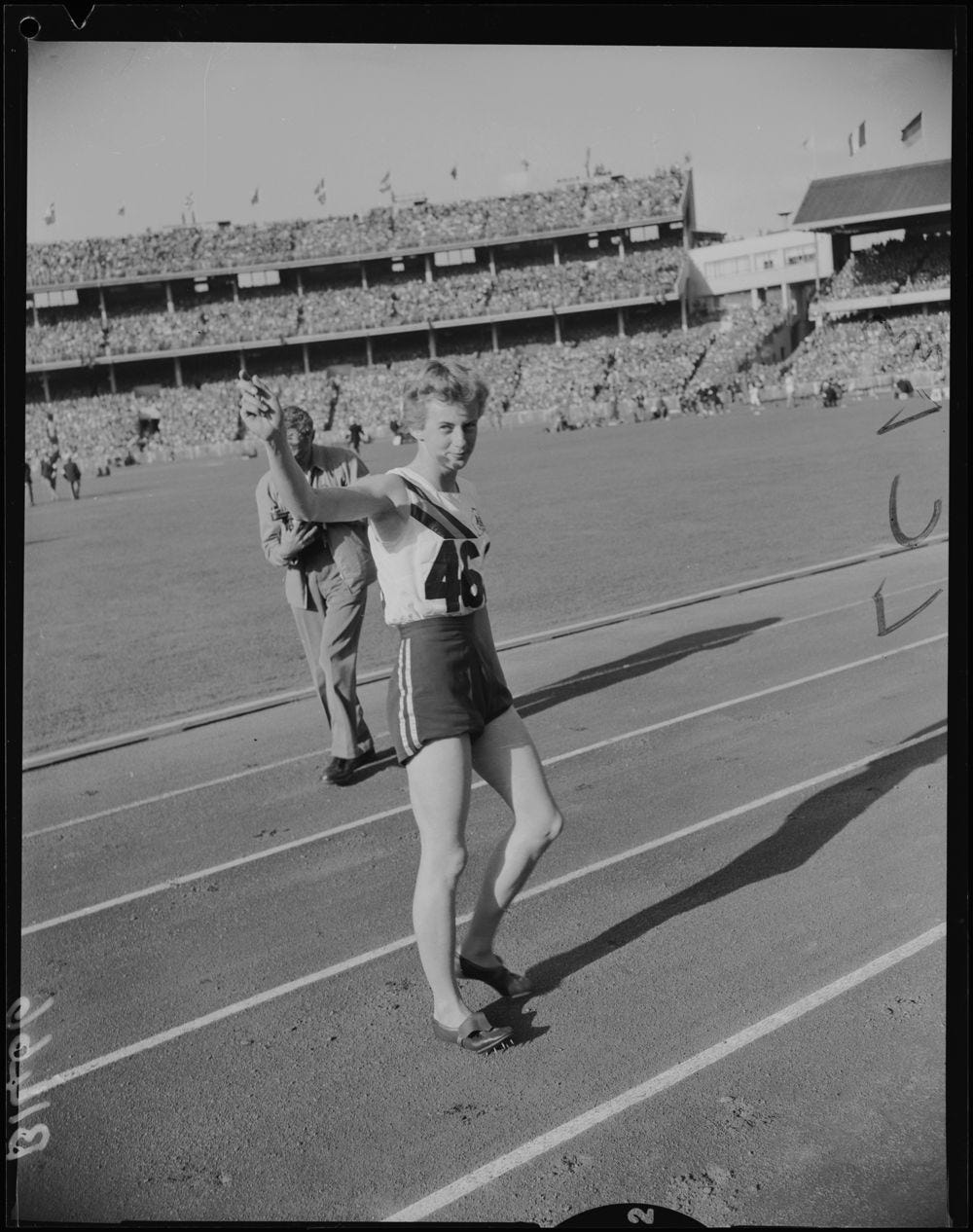
There are thousands of black-and-white photos in the archive capturing all the sports and opening/closing ceremonies. One odd thing is that none of the photos are attributed because press photographers from the time agreed for their pictures to be added to a common pool.
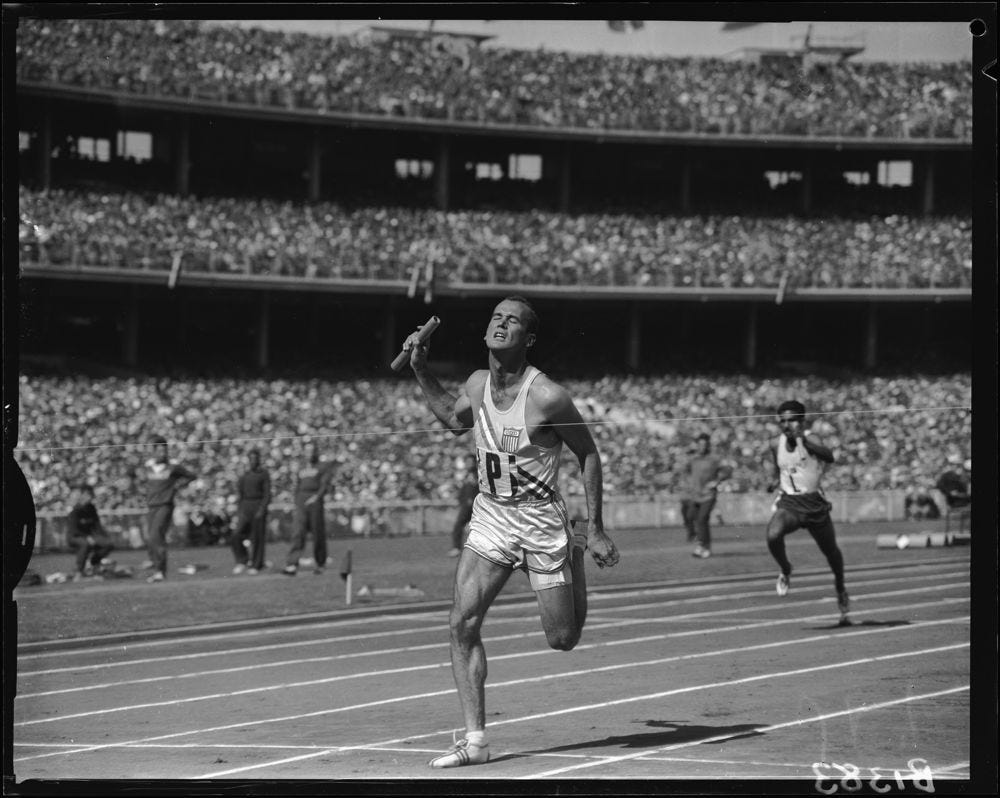
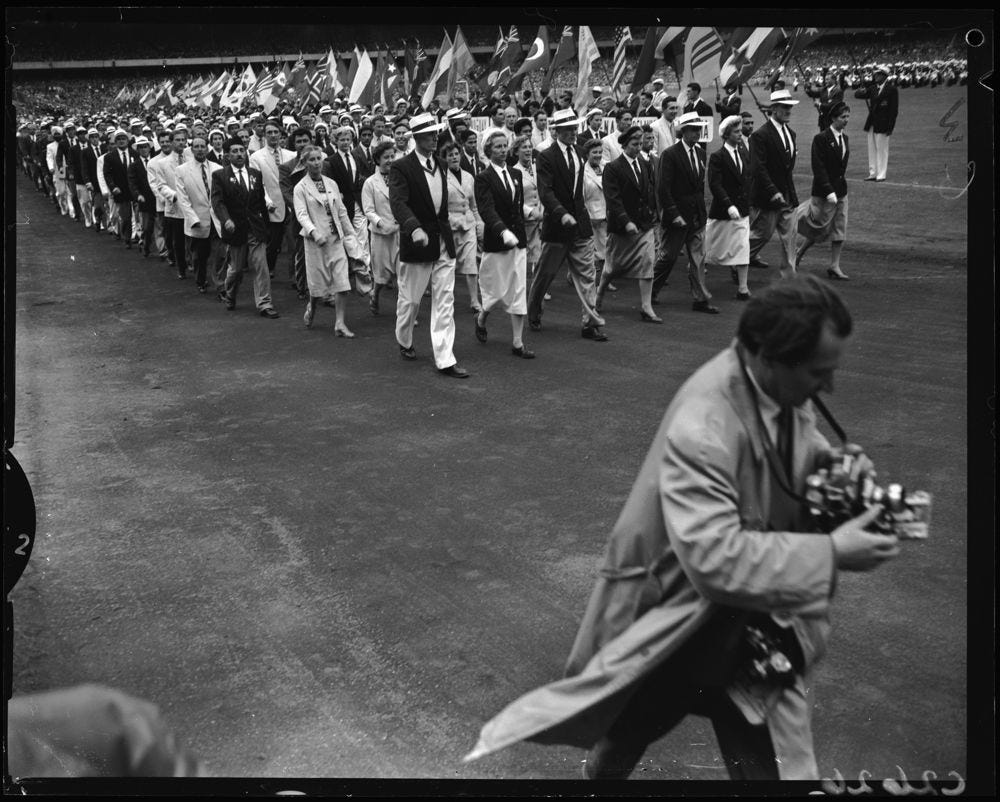
There’s a distinct school sports day vibe in all these images. Mostly it’s the material palette. Compared to modern sporting spectacle (bright saturated colours, synthetics, plastics, LED screens), mid-century sport was grass, cinders, and organic fibres like wool, leather and cotton. The looser-fitting race kits remind me of when I wore an oversized shirt and baggy shorts to Little Athletics (my glory years).
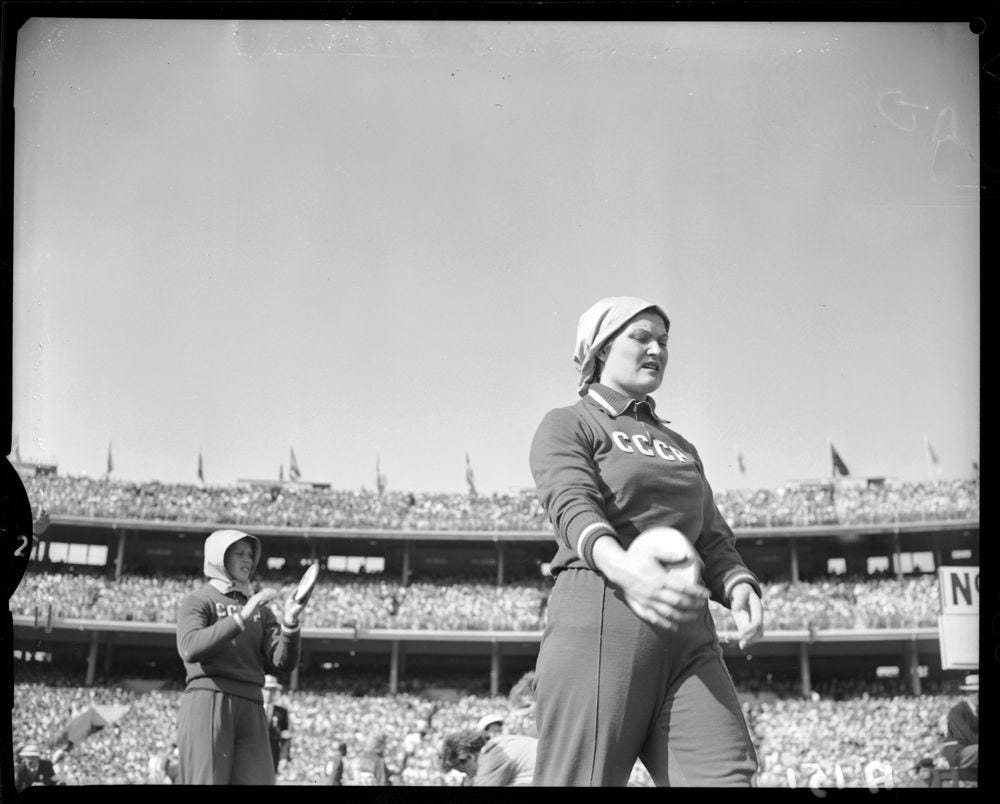
The MCG is massive and at the time supposedly could seat 120,000 but around 103,000 filled the stadium for the games. For comparison the Stade de France last year had 77,000 seats. Every one of these photos shows the three tiers of seating packed with bodies.
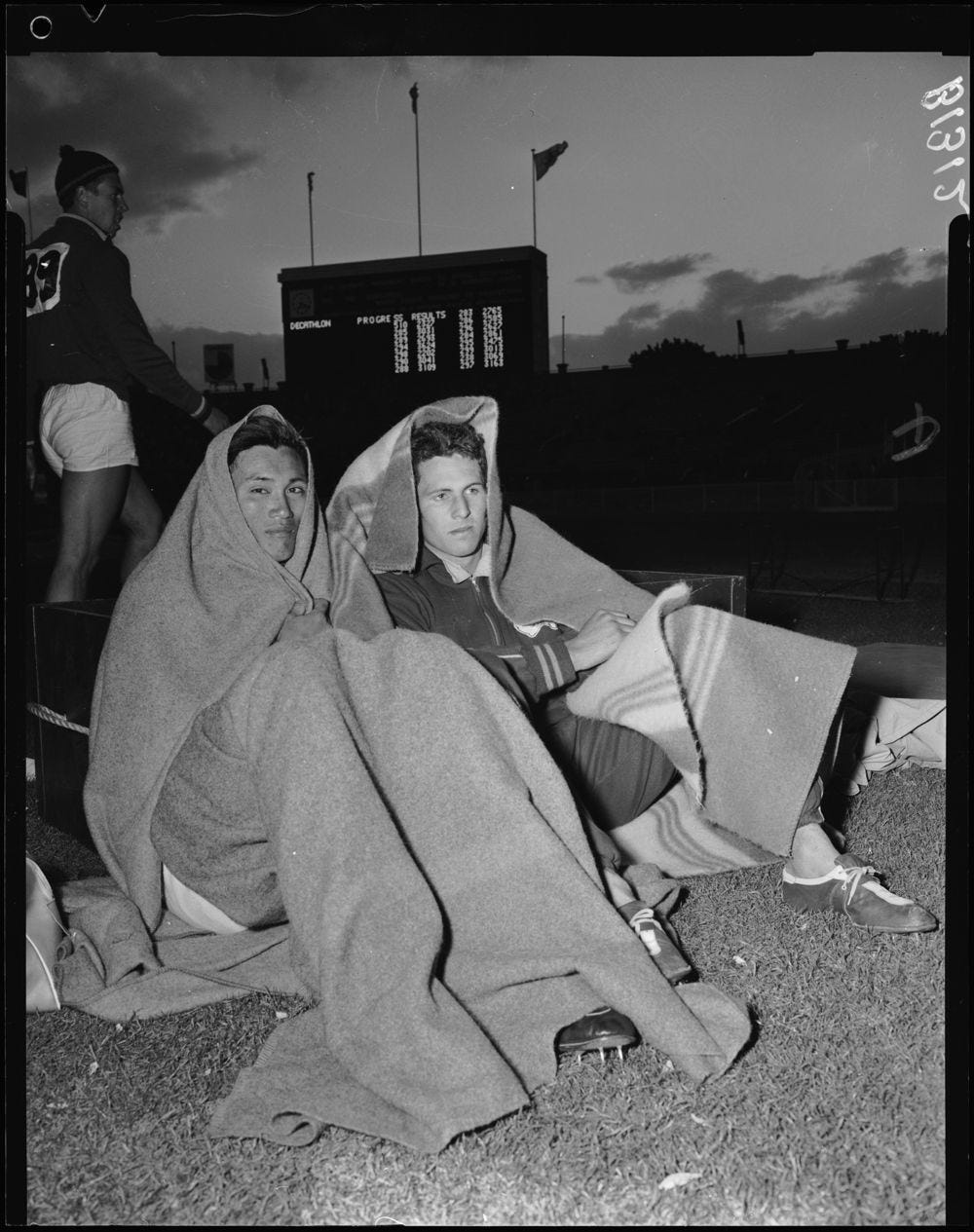
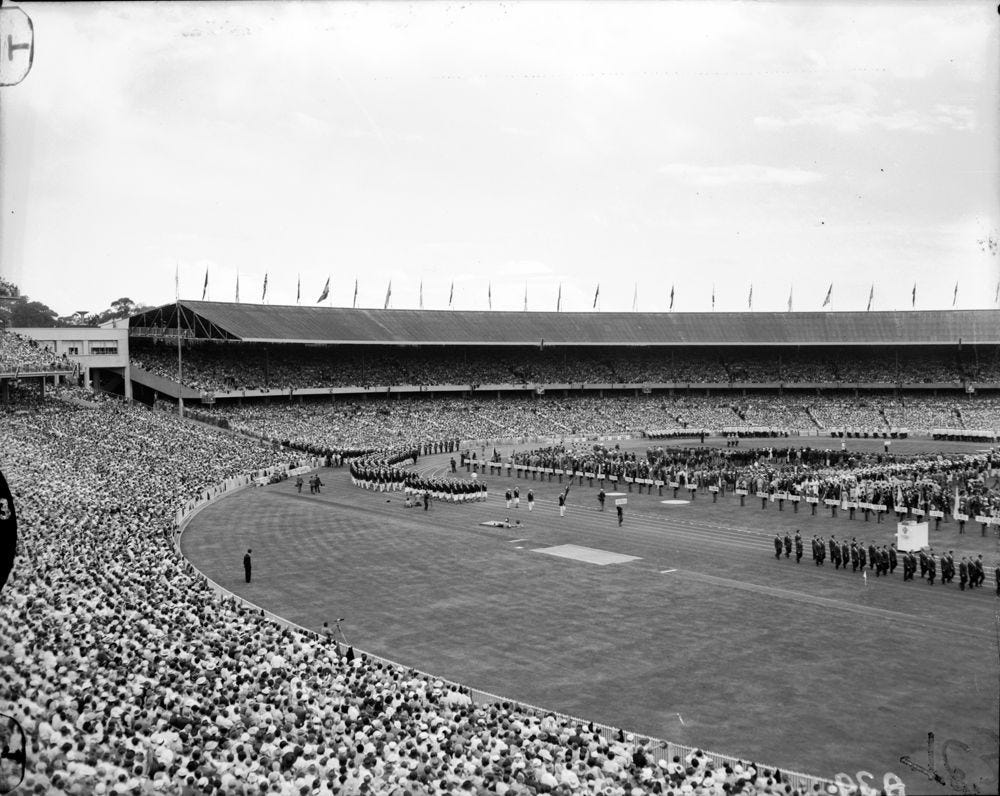
Since the stadium is primarily designed for the size of a cricket pitch, when configured for track and field there are huge chunks of empty pitch space. The athletes must have looked tiny! Not to mention there was no jumbotron for close-ups.
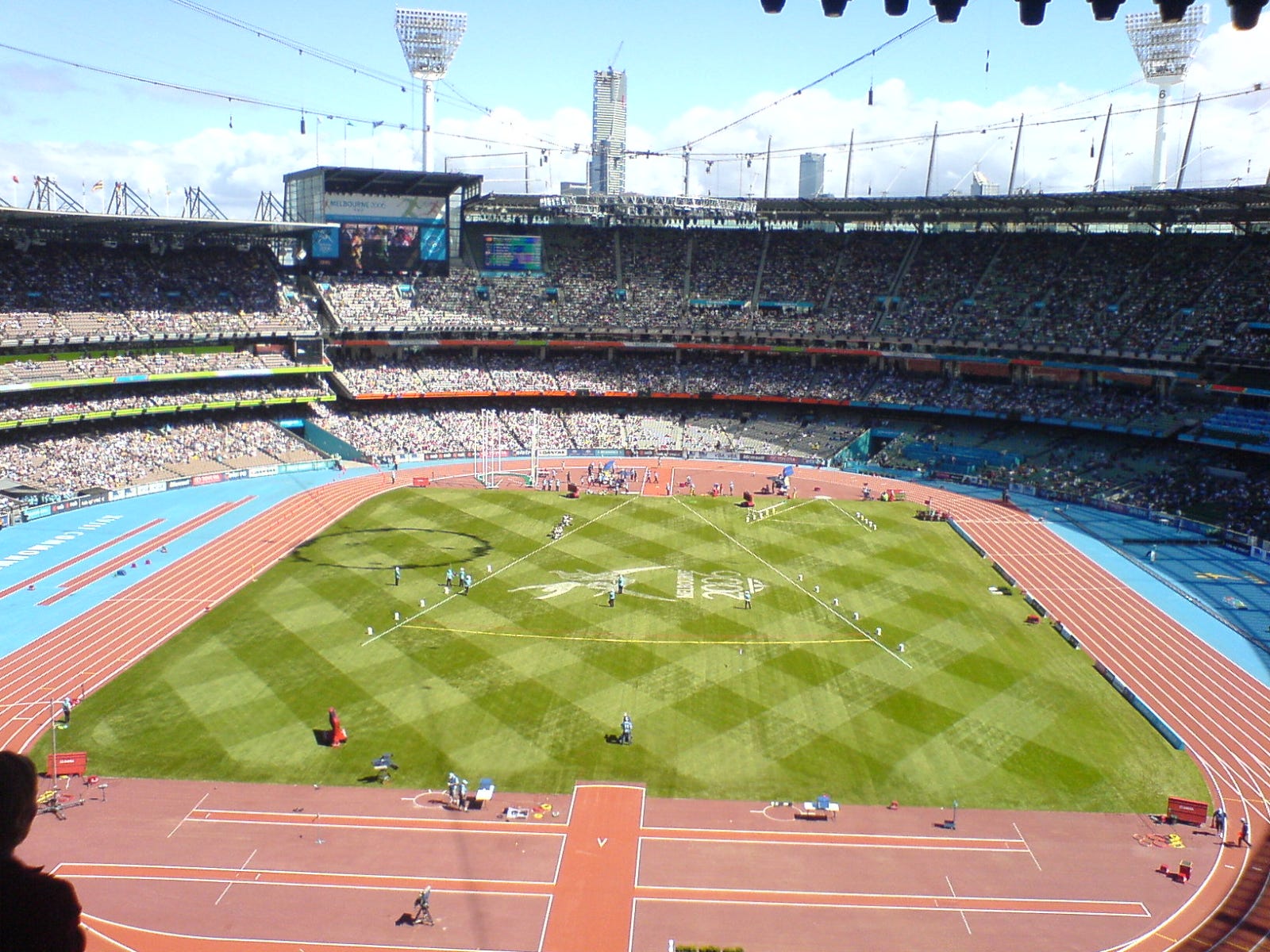
The only other major athletics event hosted here was the 2006 Commonwealth Games and in the photo below you can clearly see the extra space in blue. It makes most sense for spectators to be as close to the action as possible, but looking at these historical photos and how much drama plays out on the sidelines, we could consider bringing more of the behind-the-scenes into main view. Especially in instances like this where there is room to spare.
Field event athletes always have the luxury/curse of spending hours on the field of play so spectators can watch them go about their routines, see their reactions, and gauge their energy. This also makes for great candid photo opportunities. Track athletes are only out there for the duration of their event plus a couple minutes before and after, and maybe a victory lap or interview if you’re special. Why not have some more mingling time on the track? There is a voyeuristic satisfaction too. I’d love to watch my favourite runners do some nervous shuffling and build anticipation.
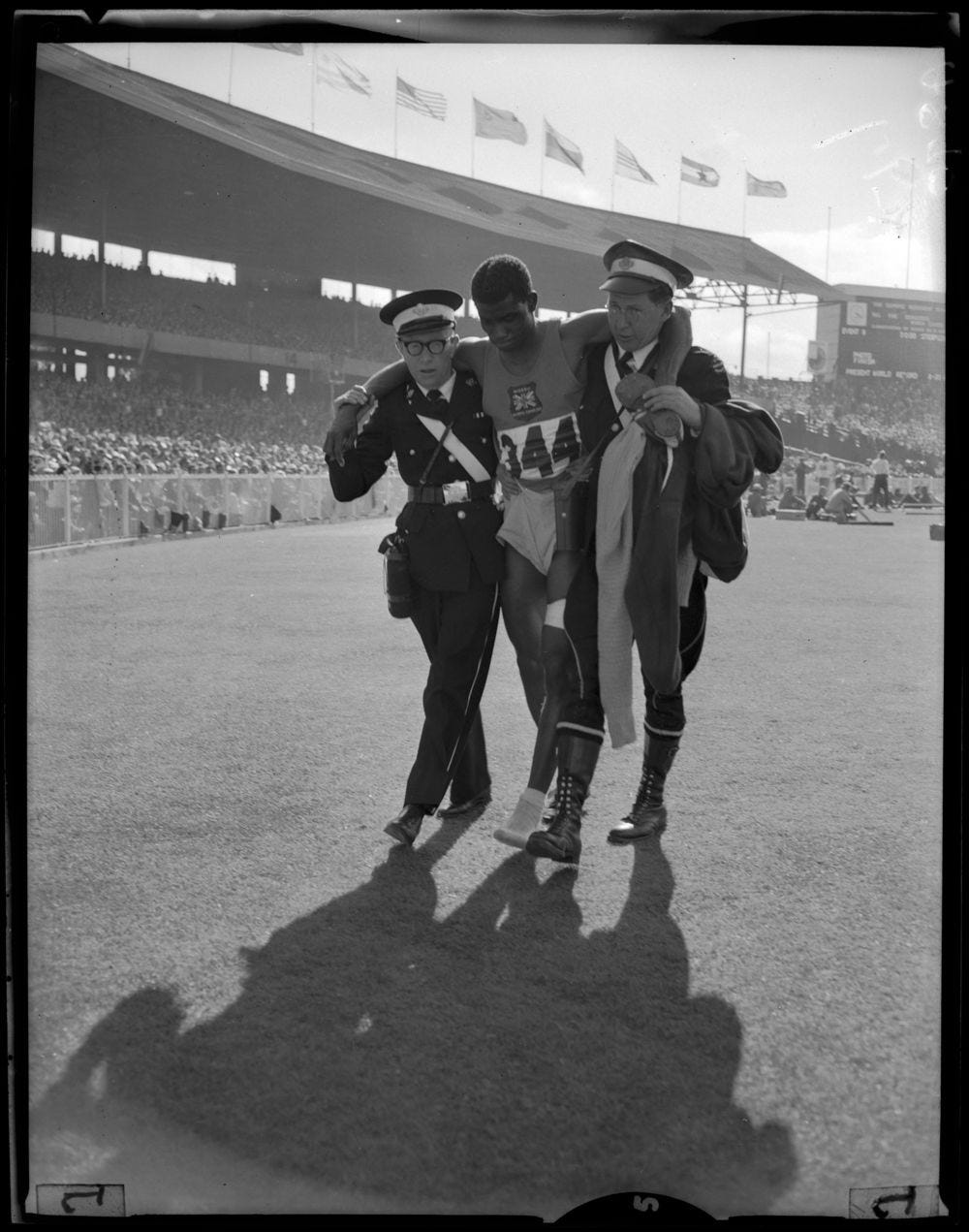
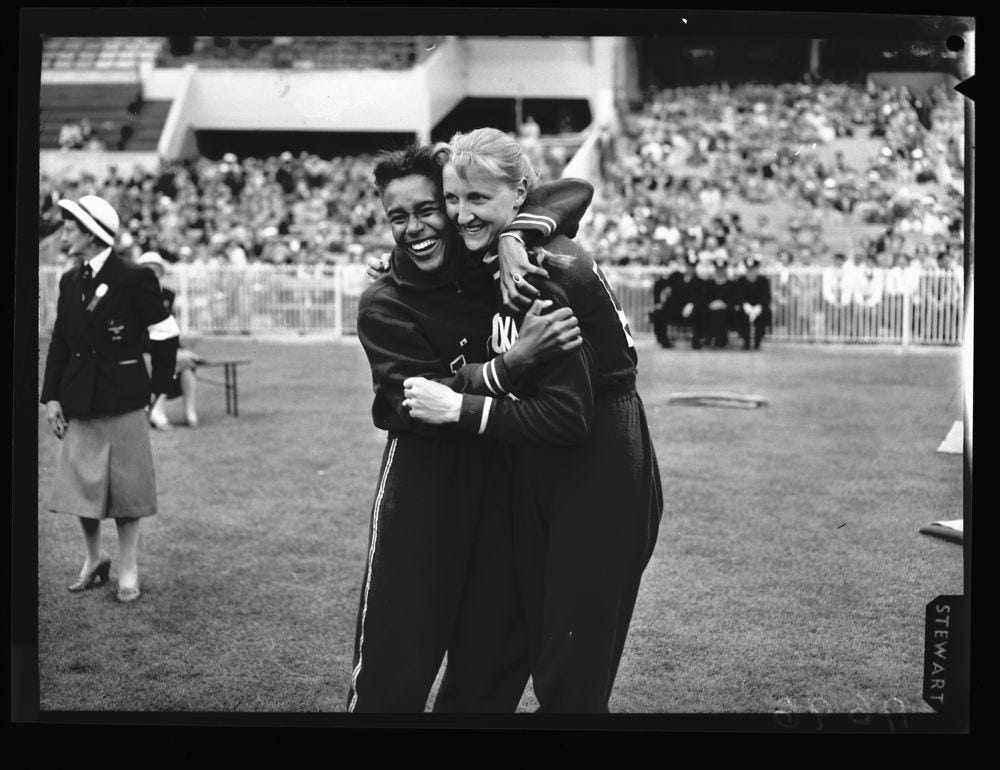
I hope one day the MCG is used for athletics again. Melbourne really fumbled; we should have hosted the 2026 Commonwealth Games in the city and recreated the spectacle of 2006 and 1956.
The MCG is a monument and a profitable, centrally located, historic and sustainable piece of sports infrastructure. A stadium is the opposite of the community running track even if they share some equipment. The community track is successful when it blends into its surroundings, becoming part of the landscape, whereas the stadium is a focal point around which everything orbits. The MCG itself is literally at the bottom of a hill with the landscape falling towards it.
If a community track is a crater, a landform, then a stadium is a gemstone sunken into a pillow. Two completely different spaces and design approaches.
xoxo Trina
A fascinating, witty read and I hope you are free to run faster than you ever have this season very soon. Good luck 👍